The global metal tile trim market was valued at US2,129 million in 2024 and is forecast to reach US3,282 million by 2031, a 6.3% CAGR.
1. Edge Protection
A glazed ceramic bullnose was fired alongside the field tile, and the transition was closed. Rectified, large-format porcelain ended that. Slabs pressed at 1200x2400mm and cut to a 90-degree mechanical edge cannot be economically produced with a matching bullnose product, and the fired glaze rarely wraps a 12mm porcelain body cleanly.
2. Stainless Steel (304/316) Profiles
At roughly 18% chromium, grade 304 forms a passive chromium-oxide film only nanometers thick that regenerates on contact with oxygen the instant it is scratched — self-healing protection no surface treatment can replicate. Grade 316 adds 2–3% molybdenum, extending that immunity to chlorides and coastal salt spray.
Stainless steel tile edge trim carries the mass and yield strength required where impact resistance is non-negotiable: commercial kitchens, hospital corridors, public transit hubs. It tolerates caustic industrial cleaning agents and steam without surface degradation, and it is 100% recyclable at end of life.
3. Anodized & Coated Aluminum Profiles
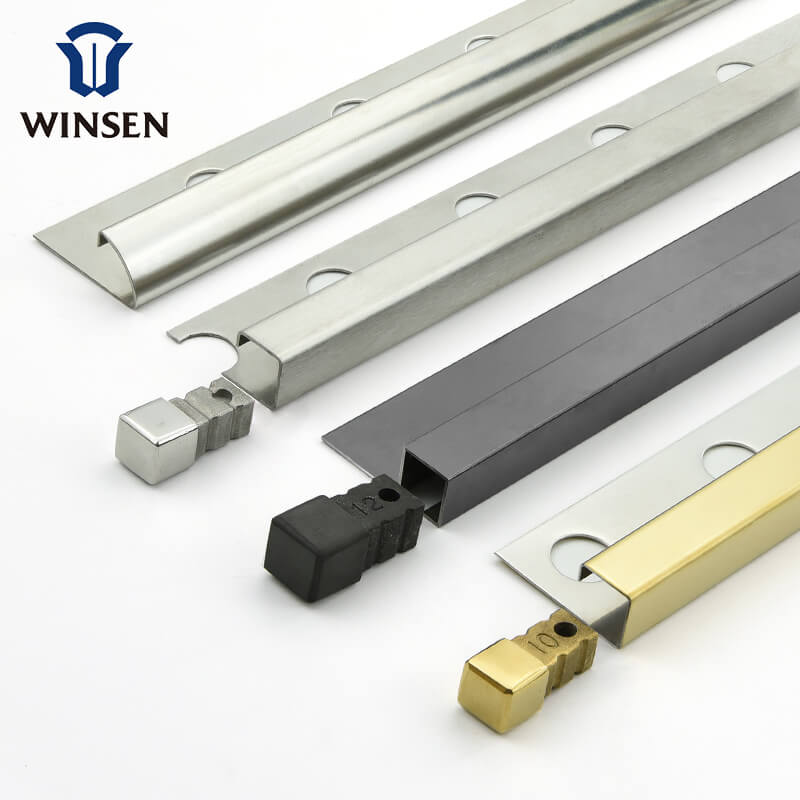
Aluminum cuts freight cost per linear meter and can be mitered on site with a standard non-ferrous blade, which is why fast-track commercial programs favor aluminum tile trim for complex geometric transitions.
WINSEN extrude predominantly in the 6000 series (6061, 6063, 6082), where magnesium and silicon deliver the balance of extrudability and temper that thin-wall profiles require; 1000-series pure aluminum is too soft, and 2000/7000-series alloys are aerospace-grade and corrode readily.
| Aluminum Alloy Series | Main Alloying Element / Composition | Common Grades |
|---|---|---|
| 1000 Series | Pure aluminum, ≥99% aluminum | 1050, 1060, 1100 |
| 2000 Series | Copper (Cu) | 2011, 2014, 2017 |
| 3000 Series | Manganese (Mn) | 3003, 3004, 3104 |
| 4000 Series | Silicon (Si) | 4043, 4047 |
| 5000 Series | Magnesium (Mg) | 5052, 5083, 5086 |
| 6000 Series | Magnesium + Silicon (Mg + Si) | 6061, 6063, 6082 |
| 7000 Series | Zinc (Zn) | 7050, 7075 |
4. Lifecycle Cost Analysis
| Factor | Aluminum | Stainless Steel 304/316 |
|---|---|---|
| Material cost index | 1.0x (baseline) | 2.2x – 3.0x |
| Density (g/cm³) | 2.70 – 2.73 | 7.70 – 8.00 |
| On-site cutting speed | Fast — standard blade | Slower — abrasive/carbide blade |
| Dent resistance (trolley/impact) | Low to moderate | High |
| Corrosion mechanism | Coating-dependent, not self-healing | Self-healing passive oxide film |
| Typical commercial floor service life | 5 – 10 years | 25+ years |
| Replacement labor exposure | High — demolish adjacent field tile | Rare |
The anchoring leg is locked in cured thin-set beneath the adjacent tile, so the crew must demolish field tile, chase out mortar, re-set, re-grout and cure — often in an occupied commercial space with lost-trading costs attached. That single intervention routinely exceeds the entire original trim package value. Stainless steel tile trim is the lower total-cost-of-ownership specification, not the premium one.
5. Failure of Installation and Mechanics
Undersize the profile and the tile sits proud, leaving an exposed arris that chips under the first impact.
Oversize it and the trim stands above the tile plane, creating a lip that catches trolley wheels and constitutes a trip hazard under commercial floor standards.
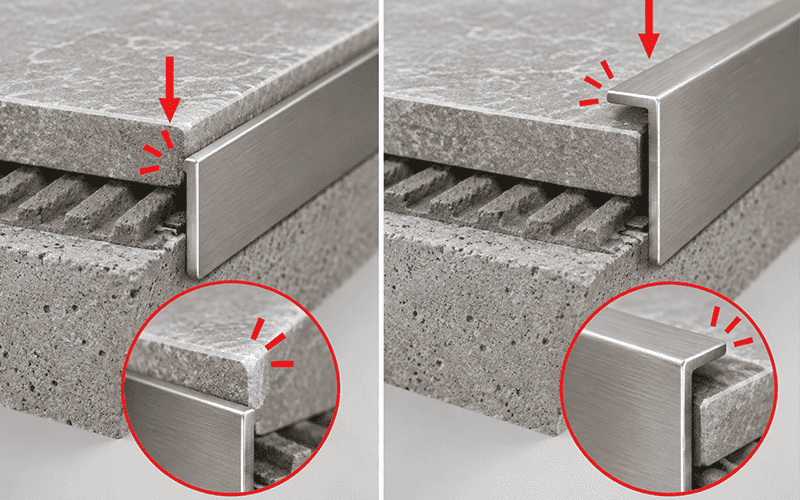
The perforated anchoring leg must be fully embedded — back-butter it and press until mortar extrudes through every perforation, because voids under the leg allow deflection and eventual fatigue at the bend radius.
6. The Specification Decision Matrix
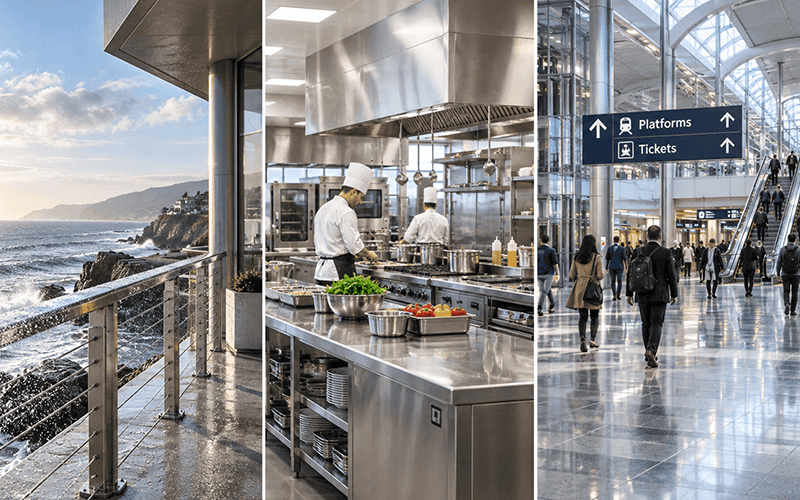
Specify stainless steel where time and traffic are the adversaries: exterior facades, coastal and chloride-exposed environments (316), commercial kitchens, transit concourses, and any heavy-wear commercial floor where replacement means demolition.
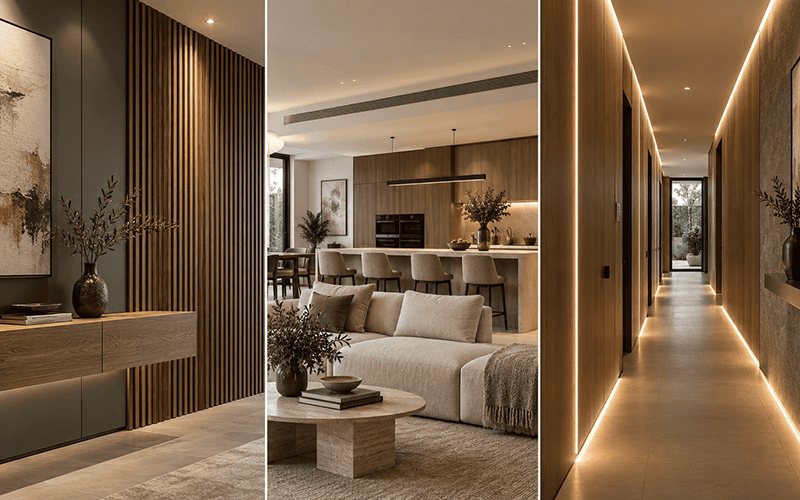
Specify aluminum where aesthetics, geometry and budget lead: custom-colored and wood-grain wall installations, curved or faceted transitions, residential fit-outs, and integrated LED detailing.
FAQ
Q1: Is aluminum tile trim safe to use in wet areas like showers?
Yes. High-quality anodized or coated aluminum tile trims are specifically manufactured for wet environments. The anodizing process seals the metal, preventing oxidation and corrosion. It is an industry standard for waterproofing shower niches, benches, and exposed edges, offering excellent longevity without the rusting risks of untreated metals.
Q2: What is the difference between “stainless steel effect” and solid stainless steel trim?
“Stainless steel effect” trims are usually made from extruded aluminum that has been brushed and anodized to mimic the look of stainless steel. Aluminum effect trims are highly popular because they are significantly cheaper, easier to cut, and will not rust in bathrooms. Solid stainless steel trim provides a heavier, more authentic premium finish but can cost up to five times as much and is notoriously difficult to cut cleanly on-site.
Q3: Should tile trim be installed before or after laying tiles?
For the most secure fit and a clean line, professional installers recommend setting the metal trim first and bedding it into the thinset mortar. However, if your walls are out of plumb, you can lay the tiles first—leaving about an inch free of mortar near the edge—and then pack the edge with fresh thinset to slide the trim piece in. This allows you to shim the trim perfectly flush with your tile face.
Q4: Why choose metal tile trim over traditional ceramic bullnose?
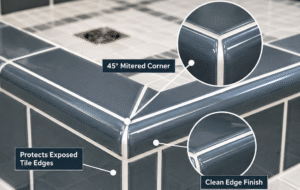
Metal trims offer a sleek, modern, and minimalistic profile that traditional bullnose tiles cannot replicate. Furthermore, many modern tile collections no longer manufacture matching bullnose pieces. Using a metal profile protects fragile tile edges from chipping and completely eliminates the need for expensive, labor-intensive 45-degree miter cuts.