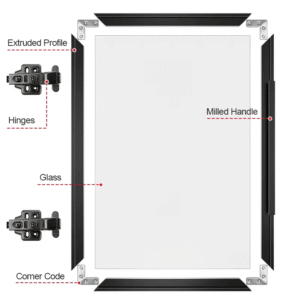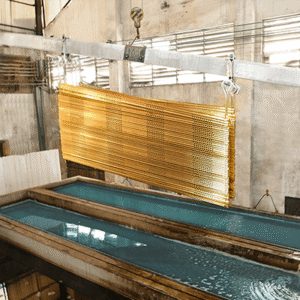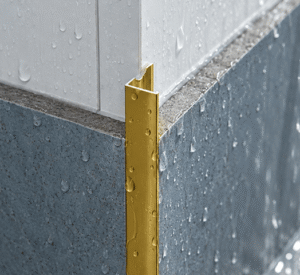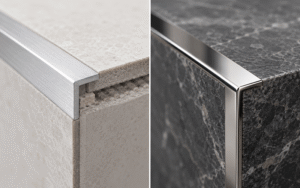
Aluminum frame cabinet doors combine a metal border with glass or another compatible insert, giving kitchens, wardrobes, and display cabinets a more open appearance. The profile does more than define the style: it determines how the panel is retained, where the handle sits, and which hardware operates the door.
Buying profiles, a frame kit, or a complete door
Profiles usually require cutting, machining, joining, and glazing. A frame kit may include selected profiles and connectors, but glass, gaskets, handles, and hinges are not automatically included. A complete door generally arrives assembled with its insert, although mounting hardware may remain separate.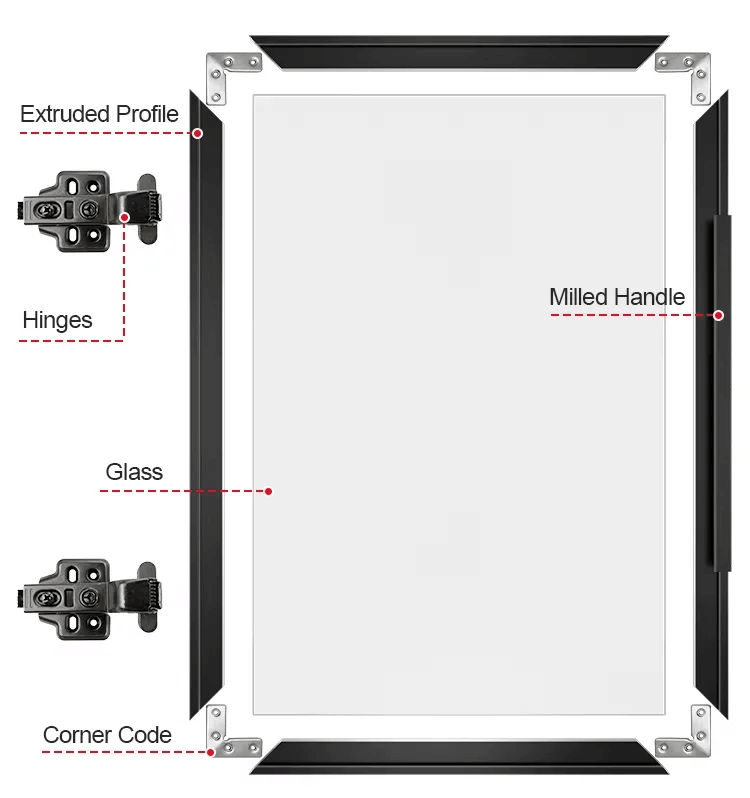
Which Frame Style Suits Your Cabinet Design?
Slim visible frames
Slim visible frames outline the glass without dominating the cabinet front. They suit display cupboards and wall cabinets where contents or internal lighting deserve attention, subject to the system’s approved dimensions.
Wider decorative frames
A wider decorative frame gives the cabinet front a stronger metal accent. Rounded or shaped sections also change how light catches the surface. Its appearance can guide the design, but stiffness, hardware compatibility, and permitted door sizes still need separate confirmation before the frame is approved for your project.
Concealed-frame glass fronts
Concealed-frame designs make the supporting metal less prominent from the front, depending on glass treatment and viewing angle. Examine the edges from the side as well as straight ahead.
Style | Appearance and visible border | Application to consider | WINSEN catalog example |
Slim visible | Fine metal outline; confirm installed sightline | Display cupboards and visually light cabinet fronts | JC5002 + JC5003 |
Wider decorative | More prominent shaped perimeter; width depends on front detail | Feature cabinetry with a stronger metal accent | JC-LJ0147 + JC-LJ0148 |
Concealed frame | Reduced apparent frame; depends on glass coverage | Glass-led wardrobe and display fronts | JC5005 + JC5006; JC5010 + JC5011 |
Aluminum Frame Cabinet Doors
Pros
- Modern appearance: Slim frames give kitchens, wardrobes, and display cabinets a clean, open look.
- Flexible design: Combine compatible glass styles, frame finishes, and handles to suit your cabinetry.
- Simple routine care: Smooth surfaces are easy to wipe when cleaned according to supplier instructions.
Cons
- Visible surface damage: Scratches and dents can stand out. Check finish samples and protective packaging.
- Glass adds weight: Confirm the complete door weight and choose compatible hinges or pivots.
- Precise assembly required: Accurate cuts, secure corners, and correct glass retention are essential. Request approved assembly drawings.
- Replacement matching: Profiles, finishes, and fittings may be difficult to match later. Record product codes and confirm availability.
Aluminum vs. Wood vs. Steel Cabinet Door Frames
Factor | Aluminum frame | Wood frame | Steel frame |
Appearance | Extruded lines; finish and handle options | Grain, painted surfaces, and joinery details | Metal character shaped by section and fabrication |
Assembly | Cutting, connectors or specified joints, insert retention | Joinery and glazing appropriate to construction | System-specific mechanical or welded joints |
Maintenance | Follow finish and glass care instructions | Follow coating and moisture-care instructions | Care depends on steel grade and protective finish |
Repairability | Damaged sections may need matching replacement | Some surfaces can be refinished; construction matters | Repair may require fabrication and refinishing |
Quotation factors | Profile, finish, machining, accessories | Species or substrate, joinery, finish, labor | Grade, section, fabrication, finish, labor |
Example: WINSEN 25-series Frame Selection
WINSEN’s 25-series F-handle arrangement pairs JC5007 with JC5008. Our illustrated cross-sections are 25.1 × 25.5 mm and 25.1 × 43 mm, with listed masses of 0.504 and 0.673 kg/m. The same spread illustrates 25-series corner connectors and hinge accessories. For an illustrative purchase of 2 m of JC5007 and 1 m of JC5008, profile mass totals 1.681 kg: (2 × 0.504) + (1 × 0.673).
How Do Assembly and Installation Work?
Inspection stage | Acceptance checks to agree |
Before fabrication | Correct profile codes, approved drawings, insert details, finish sample and hardware |
After cutting and machining | Dimensions within agreed tolerances; deburred edges; correct holes and orientation |
During assembly | Specified connectors and retention parts; aligned corners; no forced panel fit |
Before installation | Secure insert; sound glass edges; acceptable finish; correct hardware and completed dimensions |
After adjustment | Consistent agreed gaps; smooth movement; adequate clearances; secure fixings |
FAQ
Q1: What measurements do I need for aluminum frame cabinet doors?
A: You typically need the cabinet opening width and height, the desired door dimensions, and the required overlay or inset. Also provide hinge locations and the clearance between neighboring doors. Ask the manufacturer which measurements their ordering system requires before placing an order.
Q2: Do aluminum frame cabinet doors rust?
A: Aluminum does not rust like iron or steel, but it can corrode under certain conditions. A suitable finish, such as anodizing or powder coating, can help protect the frame. For kitchens and bathrooms, clean spills promptly and follow the manufacturer’s care instructions.
Q3: Are aluminum glass cabinet doors easy to clean?
A: Yes. Most aluminum glass cabinet doors can be cleaned with a soft cloth, mild soap, and water. Wipe the frame dry and use a suitable glass cleaner for the panel. Avoid abrasive pads and harsh chemicals, which can damage some finishes.
Q4: Can I use my existing hinges with aluminum frame doors?
A: Existing hinges may work, but compatibility depends on the aluminum door frame profile, mounting method, overlay, and door weight. Some slim-frame systems require specific hinges or mounting plates. Give your supplier the hinge model and door specifications before ordering replacement doors.
Sources and technical status
Primary source: WINSEN Cabinet Frame Catalog.pdf, supplied by the client. PDF page 6 / printed pages 01–02 supports JC5002 and JC5003; PDF page 7 / printed pages 03–04 supports JC5005 and JC5006; PDF page 9 / printed pages 07–08 supports JC5007, JC5008, JC5010, JC5011 and the illustrated 25-series accessories; PDF page 10 / printed pages 09–10 supports JC-LJ0147, JC-LJ0148 and its finish restriction. PDF pages 18–19 / printed pages 25–28 show finish and glass selections. Section dimensions are transcribed from drawings and are not measured installed sightlines. No unverified insert thickness, gasket model, machining allowance, alloy, temper, or completed-door capacity is claimed.
[1] Blum, Catalogue and technical manual, hinge overview: https://publications.blum.com/2026/catalogue/en/68/.