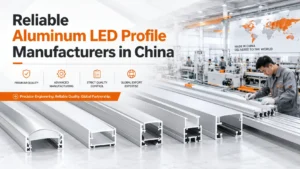
Every unprotected corner is a chip waiting to happen, and every wall-to-floor transition is a moisture entry point. In high-traffic hospitality, healthcare, and marine environments, this vulnerability compounds daily under foot traffic, cart wheels, and cleaning cycles. We position stainless steel tile edge trim as the definitive answer: a mechanical barrier engineered to absorb impact and an aesthetic finish line engineered to look intentional.
1. Why 304 and 316 Stainless Steel?
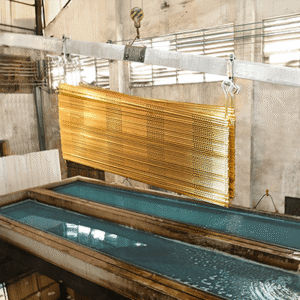
During chromizing, chromium atoms diffuse into the alloy’s surface and react instantly with oxygen to form a passive chromium-oxide layer just nanometers thick. Unlike a paint or powder coating, this layer is self-healing: scratch it, and the exposed chromium re-oxidizes on contact with air, restoring the barrier. This is the mechanism behind every 304 stainless steel tile trim and 316-grade tile edge trim stainless steel profile we produce — protection generated by the metal itself, not applied to it.
This intrinsic chemistry gives our stainless steel tile edge trim immunity to rust, moisture absorption, and chemical corrosion that aluminum and painted steel cannot match without secondary coatings that eventually wear, chip, or peel. There is no laminate to fail, no sealant layer to reapply. Submerged, splashed, or humid, the passive layer performs identically on day one & year 20.
2. Catalog of Architectural Profiles
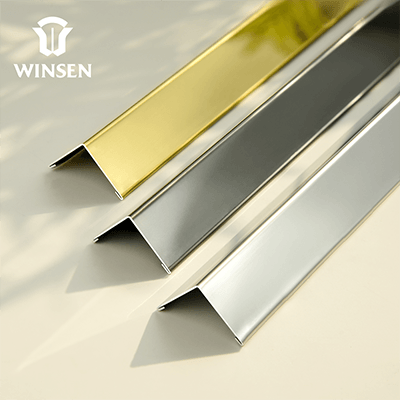
L-shaped
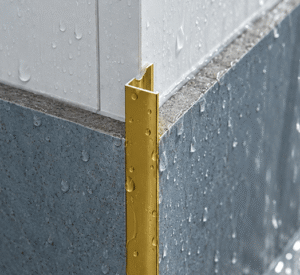
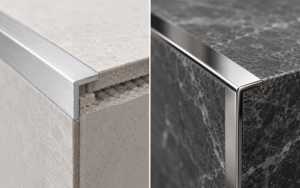
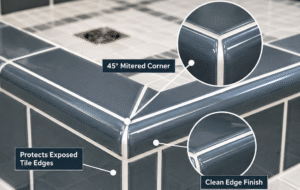
As an external corner tile trim, the L-shaped profile shields the most impact-exposed edge in any room — outside corners at doorways, columns, and counter returns — while doubling as a stainless steel internal corner tile edge trim at wall-to-floor transitions. In heavy-traffic zones like hotel corridors and retail aisles, this profile absorbs the daily abuse of carts, luggage, and foot traffic. Beyond function, the crisp visible edge of a stainless steel tile corner trim reads as deliberate framing, turning a structural necessity into decorative tile corner trim detailing.
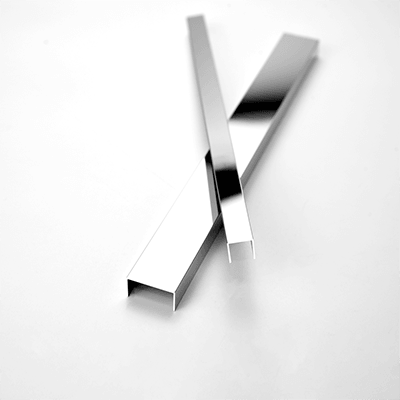
U-shaped and Square Shape
Architects specify our stainless steel divider tile trim in U & Square shape profile form to create the shadow-gap reveal now standard in corporate lobbies — a clean recessed line between tile fields, stone, or glass partitions that reads as negative space rather than hardware. This stainless steel straight edge tile trim application suits minimalist interiors where visible fasteners or bulky trim would undercut the design intent. Available in 8mm, 10mm, 12mm, and 20mm stainless steel tile trim depths, these shapes match tile thickness precisely for a flush, engineered reveal.
Modern Skirting
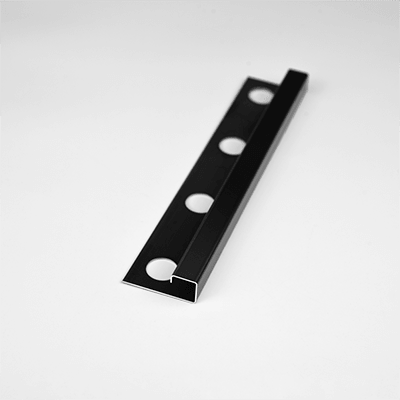
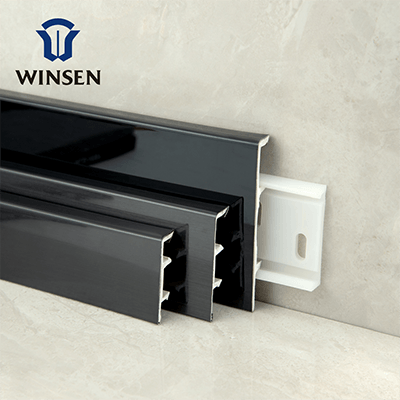
Wood baseboards absorb moisture, harbor bacteria in their grain, and require repainting. Modern stainless steel wall tile trim skirting profiles solve all three problems at once: fully non-porous, wipeable, and immune to the swelling and rot that timber skirting suffers in wet zones.
This is why stainless steel tile edge trim bathroom and hospital specifications increasingly mandate metal skirting over wood — food safety and health-code inspectors recognize a seamless, sealed profile as compliant by design. In commercial kitchens, this stainless steel metal tile border trim eliminates the grout-and-caulk joints where contaminants traditionally collect at the floor line.
Irregular Shape
Curved walls, arched doorways, and organic geometries used to force installers into segmented, mitered workarounds that compromised both strength and appearance.
Irregular shape stainless steel trim engineering solves this: a bendable profile that follows radius geometry in a single continuous run, without kinking, cracking, or losing its structural cross-section.
This breakthrough lets designers specify curved feature walls and arched niches with the same stainless steel round edge tile trim quality expected on a straight run, eliminating the visible seams and weak points that segmented trim historically introduced into non-linear architecture.

3. Advanced Surface Finishes
PVD Vacuum Coating
Physical Vapor Deposition transforms our stainless steel tile trim from a structural component into a color statement. Inside a vacuum chamber, metal atoms are vaporized and bonded to the trim surface at the molecular level, producing a layer that is thinner than paint yet dramatically harder and more fade-resistant.
This is how we produce black stainless steel tile trim, Rose Gold, Champagne, and Bronze finishes that hold their color under UV exposure and repeated cleaning cycles where electroplated alternatives would eventually dull.
Electroplating and Mirror Polishing
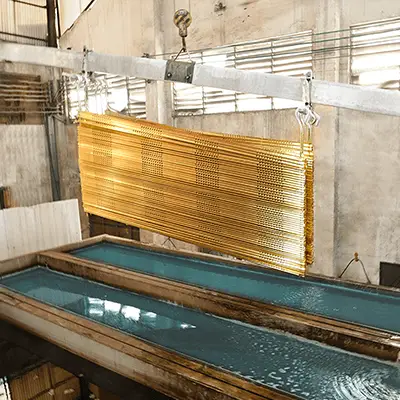
Electroplating and mirror polishing chase pure reflectivity. Our polished stainless steel tile trim uses progressive buffing to achieve a mirror-grade. Electroplating adds a bright metallic sheen at a lower cost point than PVD, making it a practical choice for large-footprint commercial fit-outs. Both processes start from the same 304 or 316 base, so the corrosion performance underneath the shine never changes.
Satin, Brushed, and Sand-Blasted Finishes
Brushed stainless steel tile trim and satin finishes use directional abrasion, including uniform sand-blasting with spherical steel grit, to produce a matte surface that hides fingerprints and micro-scratches far better than polished trim in high-touch areas.
Custom brushing direction lets us align the trim’s grain with adjacent wood flooring or natural stone veining, creating material synergy rather than contrast.
4. Initial Investment vs. 20-Year ROI
Cost is the first objection every B2B buyer raises, and we address it directly: stainless steel tile trim price sits above aluminum tile trim and plastic trim at the point of purchase. That comparison, however, stops at year one. Stainless steel tile trim holds its structural integrity for over 20 years in continuous service, while aluminum dents and plastic trim yellows, cracks, and requires replacement well within a single building lifecycle.
For wholesale stainless steel tile trim buyers stocking multi-year commercial contracts, the higher unit cost amortizes into the lowest total cost per year of any edge-protection material on the market.
Stainless steel is also 100% recyclable, which means the material retains resale value at end-of-life rather than becoming landfill waste like PVC or composite trim. Because the passive oxide layer prevents corrosion for the trim’s full service life, maintenance is limited to periodic wiping with a non-abrasive, pH-neutral cleaner — no recoating, no resealing, no replacement labor.
FAQ
Q1: Is stainless steel effect aluminium trim the same as stainless steel trim?
No. Stainless steel effect aluminium trim is aluminium with a finish intended to resemble stainless steel. Genuine stainless steel trim is made from stainless steel. Check the product’s material specification separately from its colour or finish description.
Q2: Is aluminium tile trim suitable for bathrooms?
Aluminium tile trim can be suitable for bathrooms when the manufacturer approves the product for that use. Suitability depends on its finish, installation and exposure to cleaning chemicals. Anodised surfaces need protection from scratches, and alkaline residues from wet mortar or grout can cause corrosion.
Q3: Will stainless steel effect tile trim match brushed stainless steel fittings?
Not necessarily. A stainless steel effect finish may differ in colour, sheen and surface texture from brushed stainless steel fittings. Compare physical samples beside your taps and handles before installation. Specify both the material and finish rather than relying on the colour name alone.
Q4: Can tile trim be replaced without removing the tiles?
Sometimes, but it depends on how the trim was fitted. Profiles with an anchoring leg embedded beneath adjacent tiles may be difficult to remove without disturbing those tiles. This follows from their installation method; ask a tiler to assess the actual installation before agreeing to replacement.