

Tile Edge Protection
The Ceramic Tile Foundation documents a telling case:
A hotel breakfast area finished in wood-look ceramic flooring, installed without protective edge trim. Within months, the daily impact of a housekeeper’s industrial sweeper against the exposed, un-trimmed edge caused irreparable chipping, degrading a multi-thousand-dollar installation and eroding guest confidence in tile as a durable surface.
Kinetic stress absorption, not decoration, is the real function of edge trim, and the trim & molding industry’s projected climb from 68.4 billion in 2025112.7 billion by 2034 confirms that professionals increasingly treat edge protection as non-negotiable infrastructure. (Statics from Molding & Trim Market)
Bullnose
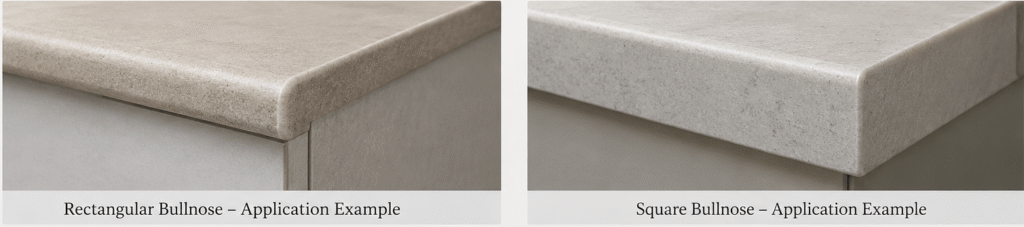
Bullnose is a factory-fired ceramic or porcelain piece with a rounded, manipulated edge that creates a seamless transition into drywall or adjacent flooring. Rectangular bullnose trims run long linear stretches on shower walls and backsplashes, while square bullnose pieces close out mosaic borders and checkered floor terminations.
Metal Profiles
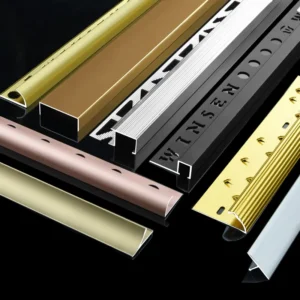
Every metallic tile profile relies on a perforated anchoring leg that embeds into combed thin-set mortar, locking the edge trim into the substrate as the bed cures. L-shaped trim deliver crisp 90-degree wall terminations; cove-shaped profiles use an internal radius to resist mold and biofilm at wet inside corners; stair-nosing and floor-to-tile transition profiles carry slip-resistant surfaces engineered for heavy structural loads.
- Anodized aluminum is lightweight and corrosion-resistant but softer under commercial foot traffic.
- Stainless steel tile trim (304/316 grade) is the standard for commercial kitchens, hospitals, and wet floors, delivering rigidity and chemical resistance that steel trims are prized for.
- Brass tile trim develops a living patina for bespoke, premium aesthetics.
- PVC tile trim is budget-friendly and flexible for curves but degrades under UV exposure and heavy abrasion.
Notably, Molding & Trim Market reports PVC as its second-fastest-growing material category, expanding at roughly 6.2% CAGR, reflecting the same moisture-resistant, low-maintenance demand driving tiling edge trim selection in bathrooms and commercial wet zones.
Mitered Corners
Mitered corners capture the luxury search intent competitors miss. A high-RPM wet saw with a variable-angle head bevels the ceramic body at precisely 45 degrees, letting two tiles meet in a sharp, borderless corner — the minimalist architect’s favorite invisible transition. But mitered edges are structurally fragile, demanding color-matched epoxy resin instead of standard cementitious grout; epoxy’s tensile and adhesive strength chemically fuses the beveled edges into an impact-resistant block, while rigid cement grout invites catastrophic chipping.
LED Integrated Profiles
The LED Profile represents where tile molding is headed next. An extruded aluminum channel functions simultaneously as a heavy-duty edge protector and a recessed housing for low-voltage LED strips. The aluminum body doubles as a heat sink, dissipating diode-generated thermal energy to prevent lumen depreciation and extend fixture lifespan — a thermodynamic advantage no plastic profile can replicate.
Installation Mastery, Pathology, and Failure Mitigation
Most tile trim corners fail from mismatched sizing. A trim too short leaves the fragile tile edge exposed above the flange, defeating its purpose; a trim too tall creates a protruding lip that traps debris and becomes a tripping hazard.
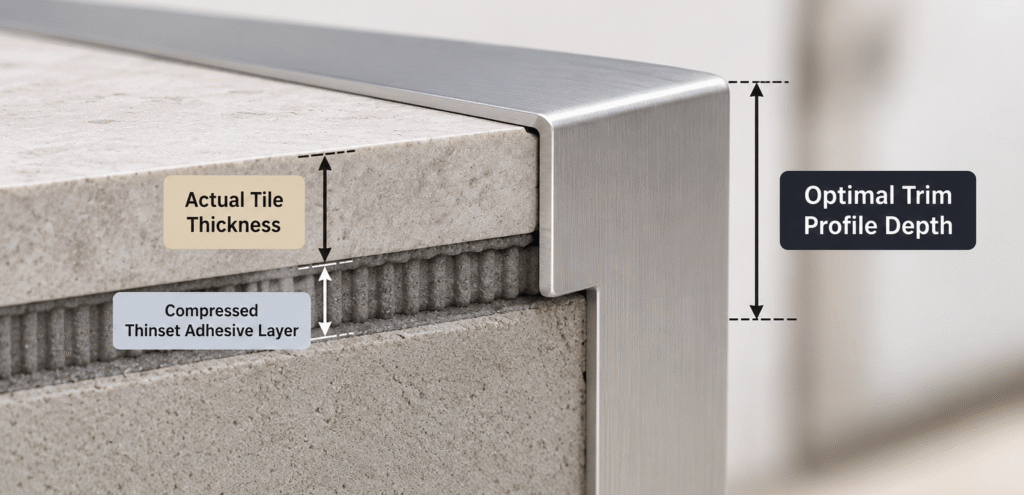
The perforated anchoring leg must be fully encapsulated in combed, modified thin-set — dry-fitting or partial coverage causes voids, rattling, water ingress, and debonding. Leave a 2mm capillary gap between rigid tile and metal edge trim, sealed with flexible silicone rather than brittle cement, to absorb thermal expansion and building settlement without stress fracturing.
Actionable Decision-making
Decision Vector | Bullnose Ceramic Tile | Metal Edge Profile | Custom Mitered Edge | LED-Integrated Profile |
| Primary Aesthetic | Traditional, Seamless, Soft, Monolithic | Modern, Crisp, Geometric, High-Contrast | Minimalist, Custom, Invisible Transition | Avant-Garde, Illuminated, High-Tech |
| Durability & Impact | Moderate (Susceptible to standard ceramic chipping) | Exceptional (Specifically Stainless Steel in high-traffic) | Low to Moderate (Highly dependent on epoxy joint integrity) | Exceptional (Aluminum housing protects both tile and LED) |
| Installation Complexity | Low (Requires standard cutting and thin-set application) | Low to Moderate (Requires accurate sizing matrix calculations) | Extremely High (Requires advanced wet-saw calibration and resin skills) | High (Requires integration with low-voltage electrical systems) |
| Cost Profile | High (Often costs significantly more per linear foot than the field tile) | Variable (Low for PVC/Aluminum; High for Stainless/Brass) | Low Material Cost, Extremely High Labor/Time Cost | Very High (Requires specialized extrusions, drivers, and LED strips) |
| Market Availability | Rapidly Declining (Rare in modern large-format or rectified tile lines) | Universal (Independent of the chosen field tile format) | Universal (Created directly from the field tile via fabrication) | Emerging (Requires specialized architectural lighting suppliers) |